A toast at the end of the evening
On November 8, 2002, the University of Chicago hosted a conference in honor of Milton Friedman, who had turned ninety that summer. Among the speakers was Ben S. Bernanke, then a governor of the Federal Reserve.
Consider the seating arrangement. Friedman had spent half a century as the Fed’s most relentless critic. His masterwork, written with the economist Anna J. Schwartz, was A Monetary History of the United States, 1867–1960, published in 1963, and its most famous chapter is an indictment. It argues that the Federal Reserve caused, or at least catastrophically failed to stop, the Great Depression. Now a serving officer of the accused institution was rising to toast the prosecution.
Bernanke was no reluctant emissary. An economist who had come to the Fed from Princeton, he had spent his own academic career studying the Depression, and he told the room he had read A Monetary History as a graduate student and “was hooked.”
Then he ended his remarks with the one sentence central bankers are trained never to say. The Fed’s own published text records it exactly:
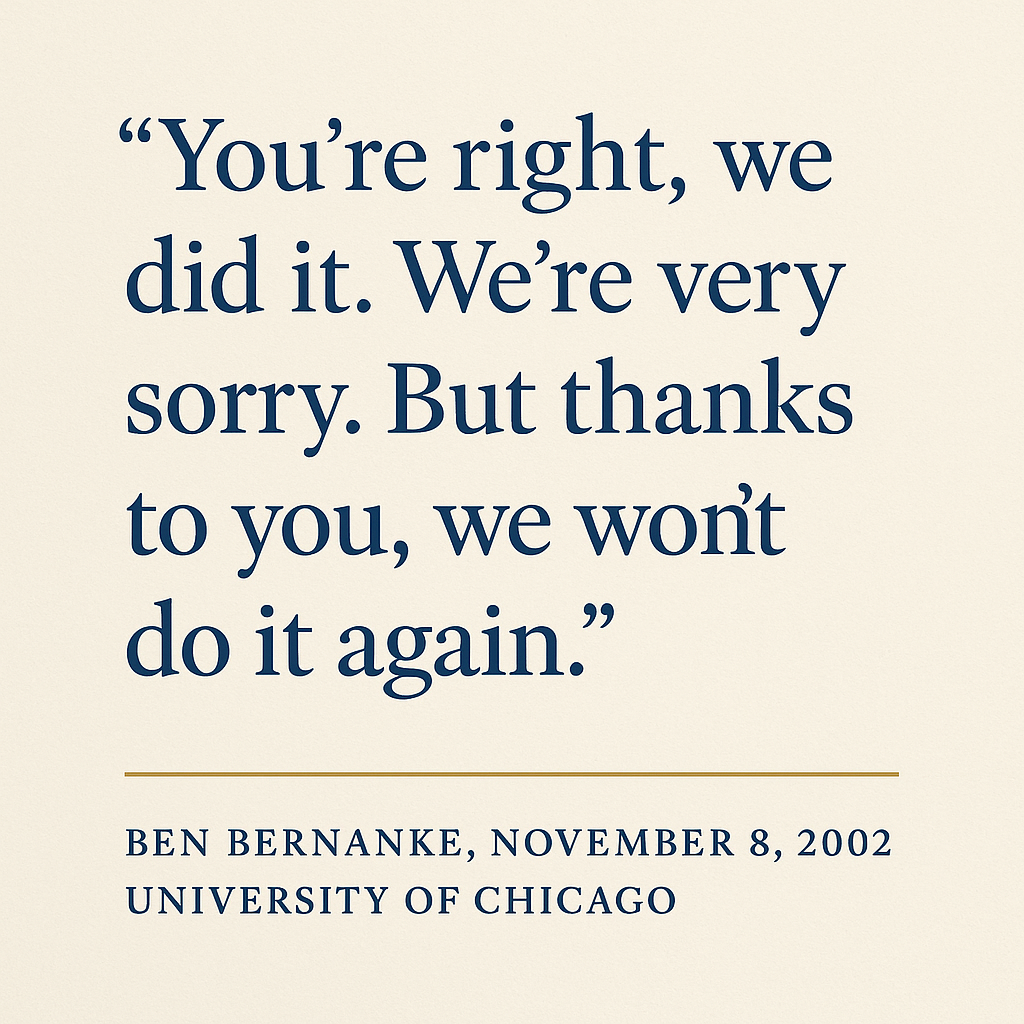
“Let me end my talk by abusing slightly my status as an official representative of the Federal Reserve. I would like to say to Milton and Anna: Regarding the Great Depression. You’re right, we did it. We’re very sorry. But thanks to you, we won’t do it again.”
And then, because it was a celebration: “Best wishes for your next ninety years.”
The most powerful financial institution on earth had just confessed to the worst economic disaster in American history. And the confession is not the remarkable part. The remarkable part came six years later, when the man who said it was tested. First, though, the confession itself: what does “we did it” confess to? Rewind seventy years.
Is it over?
It is July 2026 as I write this. On July 14, the Labor Department reported that consumer prices rose 3.5 percent in the year through June, down sharply from May’s 4.2 percent and the first pullback in the annual rate since January. The same day, the new Federal Reserve chairman, Kevin Warsh, told Congress: “There might be some that look at this morning’s data and say, ‘Oh mission accomplished, everything is swell.’ That is not my view.”
Underneath that exchange sits the question forming at kitchen tables: how does anyone, including the Fed, know when inflation is actually beaten?
The Federal Reserve’s own history contains the most instructive answer on record, twice over. Once when it did too little for too long, from 1930 to 1933. And once when it declared victory too soon, in 1936 and 1937.
One housekeeping note. The Fed’s rate-setting committee happens to meet the very week this article is published. I have no opinion about what it should do and no forecast of what it will do; forecasting remains a vice I gave up. History frames the question. It does not answer it.
The crash didn’t make it Great
Most of us carry the school version: Black Tuesday, October 1929, caused the Great Depression. The scholarship Bernanke endorsed that night says something different. The crash, Friedman and Schwartz argued, started a recession. What made it Great was what happened to money itself over the following three years: banks failing by the thousand, and the nation’s money supply collapsing, while the central bank stood by. Niall Ferguson, retelling their account in The Ascent of Money, distills the lesson: it is inept or inflexible monetary policy after an asset-price collapse that turns a recession into a depression.
If you read our last edition, a fair objection is forming. That article taught how money that quietly shrinks in value, as it did from 1966 to 1982, breaks the savers who trusted it. Now I am telling you the Fed’s founding sin was letting money vanish. So which is it? Is the Fed’s great failure printing too much, or too little?
Both. That is the honest answer, and it is the bridge between the two editions. Money that shrinks and money that vanishes both break the people who trusted it. These are the Fed’s two nightmares, and the distance between them is why central banking is hard.
One kitchen-table definition, because everything ahead depends on it. When a bank failed in 1931, the deposits inside it simply ceased to exist as spendable money. Nobody decided to print less. The money died. Deflation of this kind is not lower prices as a treat.
Why the firefighters watched the fire
Here is the part that should puzzle you: the Federal Reserve was created in 1913 largely to do exactly the job it then failed to do. Managing banking panics was the founding assignment.
So why did it stand by? Not villainy. The incentives matter, and Bernanke’s 2002 speech walks through them candidly.
Before the Fed existed, big-city banks fought panics themselves through clearinghouses. They suspended payments, vetted which banks were sound, and lent them cash, because an unchecked run threatened their own deposits. Once a public fire brigade was founded, the private one disbanded. The big banks no longer saw protecting smaller banks as their job, and some quietly regarded the weeding-out of small competitors as no bad thing.
Doctrine did further work. Many Fed officials held the “liquidationist” view associated with Treasury Secretary Andrew Mellon: purging weak banks was a harsh but necessary prerequisite to recovery. Inside that frame, standing by was not negligence. It was discipline.
And there was gold. In October 1931, weeks after Britain abandoned the gold standard, the Federal Reserve Bank of New York raised its discount rate twice in a single week, to 2.5 percent on October 9 and 3.5 percent on October 16, in the middle of a banking panic, to defend the dollar’s gold parity. Friedman and Schwartz called it, as Bernanke quoted that night, “the sharpest rise within so brief a period in the whole history of the System.” Five hundred twenty-two commercial banks closed in that one October. Defending gold was the era’s very definition of soundness.
Structure finished the job. Most of the failing banks were small banks outside the Federal Reserve System, formally not the Fed’s problem. And the System’s one commanding figure, Benjamin Strong of the New York Fed, had died in October 1928, leaving, Friedman and Schwartz argued (and it remains argued about), no one empowered to act.
Every one of these was a reason that sounded like wisdom at the time. That is the true lesson of incentives. The road to catastrophe was paved with prudence.
How the money vanished, and the coda of 1937
The chronology is compact. The first banking crisis began in October 1930. It spread, in Friedman and Schwartz’s phrase, by “a contagion of fear.” On December 11, 1930, the Bank of United States failed, at that point the largest bank failure in American history. In September 1931 Britain left gold, and in October came the Fed’s rate defense and those 522 closures. Panic followed panic, four major waves in all, until March 1933, when the new administration closed every bank in the country. The Bank Holiday: a banking system’s full stop.
Now the scale, each figure carrying its own tag. By Friedman and Schwartz’s own count, from the peak of August 1929 to the trough of March 1933, the nation’s stock of money fell by over a third. Ferguson’s tally for 1929 to 1933: some 10,000 bank failures, deposits down 37 percent, bank loans down 47 percent. And Bernanke’s own formulation that night: close to half of all US commercial banks either failed or were merged away during the Depression decade.
Numbers that size go numb. On a street, “the money supply shrank by a third” meant a savings account that was simply gone, with nothing standing behind it, and a town whose bank vanished taking its payroll lending with it. Prices fell, incomes fell faster, and debts stayed the same size.
Then comes the coda most histories skip. By 1936 the economy was finally recovering. The Fed, worried about future inflation while unemployment was still massive, judged the emergency over and doubled banks’ required reserves; the Treasury, at the same time, sterilized incoming gold. The money stock fell again, and Friedman and Schwartz concluded that the decline “significantly intensified the severity of the decline [in economic activity].” The result was 1937–38: a severe recession inside the Depression, and the clearest case on record of a central bank declaring victory too soon.
Honesty requires one more sentence. Fiscal policy tightened sharply at the same time, the federal deficit falling from $4.4 billion in 1936 to $1.2 billion in 1938, so the Fed’s tightening was not the sole cause.
Hold on to the symmetry. The Fed’s two great mistakes point in opposite directions: 1930 to 1933, doing too little for too long; 1936 to 1937, stopping too soon. We will spend that symmetry shortly.
The fair hearing
Friedman and Schwartz’s account is the one Bernanke apologized from, but it is not the only serious account, and you should hear the dissents at full strength.
The strongest is the insolvency view. Peter Temin, in 1976, followed by Eugene White, Elmus Wicker, Charles Calomiris and Joseph Mason, and Robert Hetzel, argued that the banks of 1930 were not sound institutions felled by contagious fear. They were broken banks, wrecked by a collapsing economy: failing because of the slump, not causing it. If that is right, a bolder Fed lending freely would have saved less than Friedman and Schwartz imply. The debate is alive. Bordo and Landon-Lane published econometric support for the Friedman-Schwartz side in 2010, and neither camp has surrendered.
A second dissent blames the handcuffs rather than the firefighter. In the reading associated with Barry Eichengreen’s Golden Fetters, and noted by Ferguson as well, the interwar gold standard transmitted deflation worldwide and bound every central bank that stayed loyal to it. On this view the Fed was less negligent than imprisoned by the era’s orthodoxy. The handcuffs were real, though Bernanke’s speech read the cross-country evidence the other way: countries that left gold early recovered early, which supports the monetary story.
Third, Friedman and Schwartz were subtler than their slogan. They credited the 1929 crash with deepening the decline and blamed weak business confidence for the slow recovery. The book is better than its bumper sticker.
Where does that leave the apology? Narrower, and stronger. Bernanke apologized for a failure to act against a monetary collapse, and on that specific point nearly every camp agrees the Fed of 1930 to 1933 failed. The dissents change how much blame the Fed carries. They do not change the fact that the money vanished.
The test of 2008, and the two ghosts
Now the remarkable part.
In 2008 a credit collapse arrived that rhymed with 1929. History may not repeat, but it often rhymes, and this time the chairman of the Federal Reserve was the same man who had given the birthday toast: a scholar of the fire, suddenly holding the hose. The central bank flooded the system with liquidity. Money per unit of output grew rapidly instead of collapsing. And the Great Recession, brutal as it was, did not become 1932. Bordo and Rockoff, along with many economists, argue that this is precisely why. Argue, note, is the verb. It is a judgment, not a law of physics.
And the rescue was not free. It opened the era of easy money and swollen central-bank balance sheets whose inflation you, if you read our last edition, later felt in your own grocery bills. Passing one test does not mean the Fed has it under control. It means one specific catastrophic mistake, studied honestly for forty years, was not repeated on schedule. That is the claim. All of it, and no more.
Which brings us to a frame worth keeping. Every Fed chair since 1937 has governed between two ghosts: the ghost of doing too little for too long, and the ghost of stopping too soon.
So place July 2026 where it belongs. Inflation has just fallen to 3.5 percent. The Fed chair has publicly refused “mission accomplished.” The committee meets this very week. Both ghosts are standing behind those headlines, and now you can see them. I do not know, and will not pretend to know, which ghost deserves more fear this year. Neither does anyone else. That is precisely why the two mistakes are worth knowing.
How to read Fed news like a historian
The takeaway is a habit, and it costs nothing. Whenever a Fed headline arrives, a hold, a hike, a speech, a dissent, ask one question: which ghost is this guarding against? Too little for too long, or stopping too soon? Every Fed argument of the past ninety years maps onto that axis, including this week’s.
What the habit buys is not foresight. It is calm. A reader who knows the two mistakes can watch the argument without needing a prediction, because they understand what the argument is about.
One calming inheritance deserves naming. The reason a failed bank no longer erases its depositors is that 1930 to 1933 happened: federal deposit insurance dates from the Banking Act of 1933, built directly on that wreckage. The system’s guardrails are mostly monuments to specific disasters.
And what this is not: a reason to move money, time markets, or expect either 1932 or 1937 to return on cue. PlainMoney teaches. It does not advise.
The receipt
Return, last, to the room in Chicago. In 2002 the apology was easy to hear as theater, a courtly flourish for a great critic’s birthday. Six years later it turned out to be a receipt: the rarest document in public life, proof that a mistake had been studied hard enough not to be repeated when it mattered.
Institutions do not learn from their mistakes. People do, and occasionally one of them is standing in the right place.
Robert Lucas once wrote that if he ever went to Washington for some reason other than viewing cherry blossoms, he would pack his copy of A Monetary History and leave the rest of his library, well, most of it, at home. 2008 didn’t become 1932 because somebody had read the book.
The ghosts are still there. So, now, is your ability to see them.
Keep Reading
Get the free book
PlainMoney readers start with Edmund Mercer’s free book, Why I Walked Out of My Financial Advisor’s Office — and get one calm, plain-English read on money and history every day.