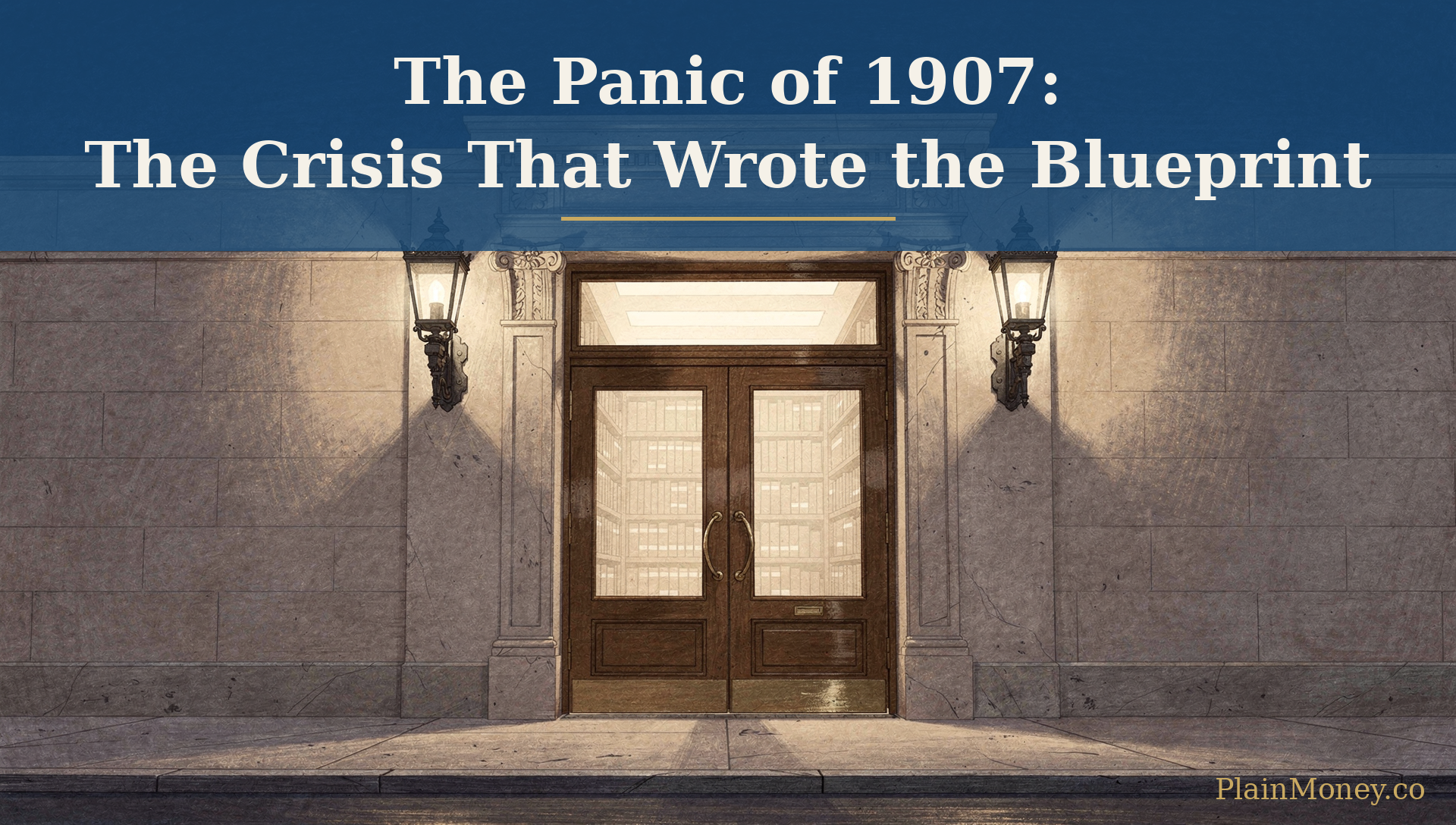
On the night of Saturday, November 2, 1907, the presidents of New York City’s trust companies were summoned to a private library on East 36th Street. The building still stands. The institution that occupies it today, the Morgan Library & Museum, tells the story of that night in its own exhibition guide: J. Pierpont Morgan “summoned the trust company presidents to his library and quietly locked the front doors.”
Keep the museum’s adverb. Quietly. Morgan, the account tells us, was “determined to resolve the crisis that evening.” Through the night they argued over who would pledge how much; by early morning, the account continues, Morgan announced “they would all sign a pledge, with each committing a certain sum for the final-stage bailout.” Then the doors opened.
I give you the scene as the museum gives it because that is the version I can check; the livelier retellings live in a memoir this desk could not open, so we print the door and skip the embroidery.
What ought to arrest you is not the lock but the question under it: how does the financial system of a country of nearly ninety million come to be settled, on a Saturday night, behind one locked private door? To answer, rewind three weeks, to a failed bet on copper.
Why an old panic is useful equipment
First, why this story earns your fifteen minutes: history issues permanent equipment, and 1907 issues three pieces.
What a run actually is: not arithmetic but a network of confidence, where the map of who trusts whom is never quite the map of who owes whom.
Where risk goes: wherever the rules are thinnest. The Federal Reserve’s own historians describe the era’s trust companies as functioning like “shadow banks.” The vocabulary is theirs, not mine.
And what “lender of last resort” means, demonstrated in America before the phrase had an American address.
Framing honesty: this panic story ends in restored calm; that is why a publication allergic to doom can tell it slowly, on the record.
Last week this letter rode a private railcar to an island off Georgia. This week we go back three years, to the October that convinced every man on that train the trip was necessary. If you missed the railcar, no matter: this story was always the first chapter.
What both camps get wrong
Both the Fed’s admirers and its critics tell this story as a verdict, and both, I think, skip a step.
Camp one: 1907 proved America needed a central bank, the panic as necessity’s proof. Camp two: 1907 was the pretext, the panic contained, the private rescue successful, the Federal Reserve opportunism dressed as reform. Both do the same thing from opposite directions: deliver a verdict on an institution by reading the biography of its authors. An origin story is evidence about the authors, neither an acquittal nor a conviction of the thing they built.
And there is a puzzle neither camp likes to sit with: by one careful scholarly measure this was not even the worst panic of its era, yet it is the one that produced the central bank. Hold that thought.
One correction on the way in: two speculators were the trigger; the conditions were the cause. So set the verdicts aside and look at the machine, starting where the risk had quietly pooled for a decade.
The shadow banks of 1907
A trust company, in 1907, was a state-chartered institution that had begun as a manager of estates and had evolved into something close to a bank: it took deposits, paid interest, and made loans, but under lighter rules than the national banks across the street.
The Fed’s historians put the gap plainly: trusts “held a low percentage of cash reserves relative to deposits, around 5 percent, compared with 25 percent for national banks.” The “around” is theirs; keep it.
By Ellis Tallman and Jon Moen’s account in the Atlanta Fed’s Economic Review (1990), New York trust assets grew 244 percent in the ten years ending 1907, to roughly $1.4 billion; their later Cleveland Fed survey ranks the trusts second only to the national banks in New York assets and deposits. I will not translate 1907 dollars into modern ones: no honest converter is to hand, and rank tells the story better.
The New York Clearing House was the private association through which the city’s banks settled accounts and, in bad weather, protected one another. In 1903, by Moen and Tallman’s account, it resolved that nonmember institutions clearing through its members must hold at least 10 percent cash reserves by 1904. Rather than comply, the trusts walked out. O. M. W. Sprague, in the official history of the era’s crises, records that nearly all gave up clearing privileges, “the most important exception, curiously enough, being the Knickerbocker Trust Company.” The irony is his; remember the name. In 1906 New York State finally imposed a reserve requirement on trusts: 15 percent, only 5 percent in vault cash.
The incentives matter more than the villains, of whom this story has none. Every actor was behaving sensibly. The trusts grew where the rules were thinnest and declined to hold reserves the law did not demand and club membership would have priced. The Clearing House was mutual protection of members, funded by members; the boundary was not a flaw in the design, it was the design. And the sum of all that good sense was a system whose risk had pooled exactly where the safety net ended.
Then, in the third week of October, two men tried to corner a copper company, and everyone found out where all that sensible behavior had put the risk.
The panic, day by day: October 16 to November 6
Wednesday, October 16. In the Fed historians’ words: “two minor speculators, F. Augustus Heinze and Charles W. Morse, suffered huge losses in a failed attempt to corner the stock of United Copper, a copper mining company traded on the curb,” the curb being the outdoor market that became the American Stock Exchange. Runs hit the Heinze and Morse banks; the Clearing House examined and supported them, then purged their management. The club worked, for members.
Friday, October 18. Depositors learned that the Knickerbocker’s president, Charles T. Barney, was an associate of Morse. The Knickerbocker was, per Sprague, “the third largest trust company in New York, having deposits of $62,000,000.” (1907 dollars, like every figure here.) The run began. The pivot fact: the Knickerbocker held no copper. Contagion traveled on association, not exposure.
Monday, October 21. The Clearing House denied a loan request on the trust’s behalf “because its resources were reserved for the support of its member institutions.” Overnight, Morgan sent in a thirty-four-year-old examiner: Benjamin Strong, “then a vice president at Banker’s Trust and later the first head of the Federal Reserve Bank of New York.” The result: “In the short period of time available, Strong could make no definitive determination of Knickerbocker’s solvency. Morgan therefore refused to aid the trust.” Not insolvent; undeterminable in the time available.
Tuesday, October 22. Depositors withdrew nearly $8 million in about three hours; the Knickerbocker suspended just after noon. Call money, the overnight credit brokers live on: the annualized rate “jumped from 9.5 percent to 70 percent, then to 100 percent two days later. At times, there were no credit offers at that rate.”
Wednesday, October 23. The run turned to the Trust Company of America, “the second of the trust companies in size, having deposits of $64,000,000,” Sprague again. Per the Fed’s historians: “Morgan changed his mind and quickly released aid, as did the New York Clearing House banks. However, depositors continued to withdraw funds from Trust Company of America for two more weeks.”
Thursday, October 24. Two different $25 millions moved that day, and historians have been merging them ever since. The government’s: Treasury Secretary George Cortelyou deposited $25 million in New York national banks, per Tallman and Moen’s Cleveland Fed account; over October 21 to 31 the Treasury placed $37.6 million in all, plus $36 million in small bills. Standing practice scaled up, not an invention, six years before the Fed. The banker’s: Morgan formed a money pool for the stock exchange, $25,000,000 by Sprague’s count. The Fed’s essay: “The New York Stock Exchange remained open largely because of the legendary actions of Morgan, who solicited cash from large financial and industrial institutions and then had it delivered directly to the loan post at the exchange to support brokers who were willing to extend credit.”
Saturday, October 26. The Clearing House authorized clearing-house loan certificates, settlement paper that freed cash for depositors: roughly $90 million outstanding at the peak, about $100 million issued in all, per a 2022 study in Yale’s Journal of Financial Crises. The same day the banks restricted the convertibility of deposits into cash. The Fed’s historians: “This action severed the par exchange rate between deposits and cash, thereby leading to a cash premium and a substantial influx of gold imports from abroad.”
Now the under-told half: for most Americans this was never a Wall Street panic. “[H]ard upon the news of the difficulties of the Knickerbocker Trust Company came telegraphic demands from all over the country ...” Sprague writes. Restriction spread through the correspondent system; his nationwide survey found “only 6 States from which I have no record of restriction of payments ...” Cash went to a premium: “the premium on currency in Philadelphia ranged from $1.50 to $3 per $1,000.” And nearly $500 million in currency substitutes circulated over the course of the panic, by A. Piatt Andrew’s estimate, carried in Jon Moen’s EH.net survey.
Back to the library. On Saturday, November 2, the brokerage Moore & Schley neared collapse, its loans backed by Tennessee Coal, Iron and Railroad stock. That night the presidents were summoned and the doors locked; by morning there was a pledge. On Monday, November 4, President Theodore Roosevelt, having met Elbert Gary and Henry Clay Frick of U.S. Steel, declined to object to its acquisition of the coal company; Moore & Schley was relieved. I narrate rather than quote that meeting: its record circulates in two wordings, neither read at the document.
Wednesday, November 6, in the official history’s dry register: “announcement was made that a majority of the shares of the Trust Company of America and of the Lincoln Trust Company had been placed under the control of a committee of trust company presidents.” The certificates were retired by March 28, 1908; the Knickerbocker, never proven insolvent, reopened that March after a $2.4 million infusion.
The panic ended. Calm returned. And there the argument begins: two very different lessons can be drawn from a rescue that worked.
The strongest case, and its limit
First, the case that the system righted itself.
There was a structure. The Fed’s historians: “The private New York Clearing House provided a structure for addressing crisis events, and it imposed rules and standards on member bank behaviors to discipline members and maintain sound practices.” Its loan certificates worked well enough that the same historians call them “the predecessor to discount window loans from the Federal Reserve System.” The Treasury backstop existed and was used. Every National Banking era panic, this one included, ended without a central bank. And the strongest card: the decentralized emergency currency created after 1907 was used at the outbreak of war in 1914, peaked at $364 million outstanding, and is credited in Yale’s case study of the episode with preventing a panic. Critics of the 1913 reform can fairly hold that card.
Now the limit, from the same record. The structure was a club. Sprague again: “Had the Knickerbocker Trust Company been a bank and a member of the clearing house, it is highly probable that it would have been assisted ...” The “highly probable” is Sprague’s. The contraction of loans and deposits in New York City during the panic, Moen and Tallman’s study finds, “was confined to the trust companies”: the far side of the wall. Above the club stood exactly one coordinator, a private, unelected, seventy-year-old man. And the club’s chosen instrument carried a national bill: Sprague’s own charge is that the banks restricted payments, “thus involving all branches of business in severe strain.” His verdict; I report it.
Then the Morgan question, which I will neither settle nor hide. Savior, at strength: “But for the powerful influence of Mr. J. P. Morgan it is probable that no united action whatever would have been taken.” The official history speaking, hedge included. Self-dealer, at strength: the test that condemned the Knickerbocker was one overnight examination that reached no determination; the institutions saved were his counterparties; and the rescue’s final act delivered a coal-and-iron company to U.S. Steel at panic prices with a presidential assurance in hand. Contemporaries said so loudly enough that Congress later convened the Pujo hearings. The historiography, exactly: two sentences in the official history; two chapters in the son-in-law’s memoir; “legendary” in the Fed’s essay; “inefficient and clumsy” in the specialists’ survey (the Cleveland working paper, on the money pools). Four attributed registers; no verdict required, and none issued.
Here I part company with both camps, narrowly. Any sentence that slides from “1907 showed the system could fail” to “1907 showed the Fed was necessary” has smuggled in a step; so has one sliding from “the clearing houses coped” to “no central bank was needed.” The record supports neither slide.
The paradox, and the blueprint for the Fed
Let’s zoom out and resolve the puzzle. Two findings, both from Moen and Tallman, both true. In a 1999 working paper: “The 1907 panic displayed a less severe output contraction than other national banking era panics.” In the same scholars’ 2015 Fed history essay, the panic “transformed a recession into a contraction surpassed in severity only by the Great Depression,” with industrial output down 17 percent in 1908 and real GNP down 12 percent, the essay’s figures. Two questions, no contradiction. One compares the output contraction of 1907’s panic window with the era’s other panics; the other sets the 1907 to 1908 slump against the whole pre-Depression record. A panic can be a milder banking event and still accompany a severe output year.
Severity, then, is not what made 1907 the origin story. Incentives were: the panic broke outside the club and converted its members. In the scholars’ words: “The reform proposals from New York banking interests advocated universal membership in a centralized reserve system to overcome the risk of financial panic arising from the observed isolation of some intermediaries.” The politicians’ problem was different again: the system had been saved by one old man, and “never again one old man” is a fact about politics, not a verdict on the remedy.
The chain that followed is documented at every link: the Aldrich-Vreeland Act, “Approved, May 30, 1908,” created an emergency currency and declared, in the statute’s own words, that “a Commission is hereby created, to be called the ‘National Monetary Commission.’” The commission then commissioned Sprague’s history of this very panic: the book this article has been quoting. In November 1910 the commission’s work took a private railcar to an island off Georgia. Frank Vanderlip, who was aboard, later said: “We were trying to plan a mechanism that would correct the weaknesses of our banking system as revealed under the strains and pressures of the panic of 1907.”
Notice the verbs. The panic “preceded the successful movement” toward a central bank; it “spurred the monetary reform movement that led to” the Fed. Each keeps a careful distance from “caused,” and the distance is honest work. Documenting the chain does not certify its final link. That distinction is the tool worth taking home.
Three questions to keep
Here is the method, then; a method, not advice. The next time anyone argues from an institution’s origin crisis, separate three findings the record keeps separate.
Was the emergency real? In 1907, yes. The record is unambiguous.
Did the improvised response work? Largely, for members. The non-members, and the depositors of all but six states, where cash was rationed, are part of that answer too.
Does either fact certify the permanent remedy built afterwards? No. A remedy has to be judged on what it does, on its own record: an evaluation this article has deliberately not performed.
Apply the method symmetrically. When someone tells you 1907 proves the Fed was necessary, or that the Fed’s flaws prove 1907 was a pretext, you now own the step both are skipping.
The method has a cost: it leaves you without a verdict today. That is the price of claiming only what the record supports; a real price, and the difference between knowing a story and being armed by one.
The morning after
Early on Sunday morning, November 3, the pledge was signed and the library doors opened. The men went home. The panic subsided into winter; by spring the Knickerbocker was open again.
The political system looked at that locked door and resolved never to depend on it again. Everything about that resolution was understandable. Nothing about it settled whether what they built instead was sound. Both sentences are true at once; a careful reader can hold both.
The names change. The instruments change. The pattern, an emergency improvisation hardening into a permanent institution, changes more rarely. The men in that library, and the men they frightened, will keep appearing in this story.
Related reading
John Law and the Mississippi Bubble
Keep Reading
Get the free book
PlainMoney readers start with Edmund Mercer’s free book, Why I Walked Out of My Financial Advisor’s Office — and get one calm, plain-English read on money and history every day.